Fired, then rehired: what 6 CEO comebacks teach founders about board control
Altman, Iger, Dorsey, Schultz, Jobs and now Jensen Huang all lost the CEO job and got it back. Here's who decides, and what founders should negotiate early.
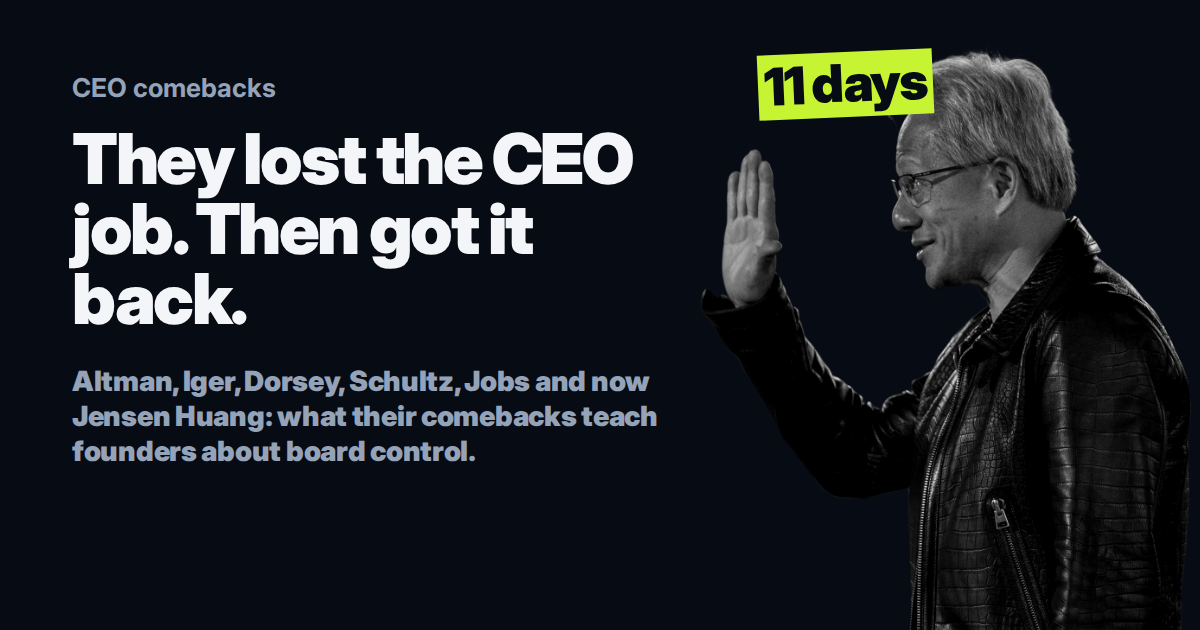
Nvidia's board just took Jensen Huang back as CEO, 11 days after he resigned. He's the latest in a short list of famous CEOs who lost the job and got it back. Every one of those stories was decided in the same room: the boardroom.
On November 12, 2026, Nvidia announced that Huang had resigned as CEO and that CFO Colette Kress would serve as interim CEO, according to the company's filing with the SEC. On November 23, the board reinstated him. Eleven days, start to finish.
That's fast, but it isn't the record. And the other comebacks are worth knowing, because they show something many founders only learn the hard way: the CEO works for the board, even when the CEO started the company.
Five CEOs who came back first
Here are five well-known comebacks, shortest gap first.
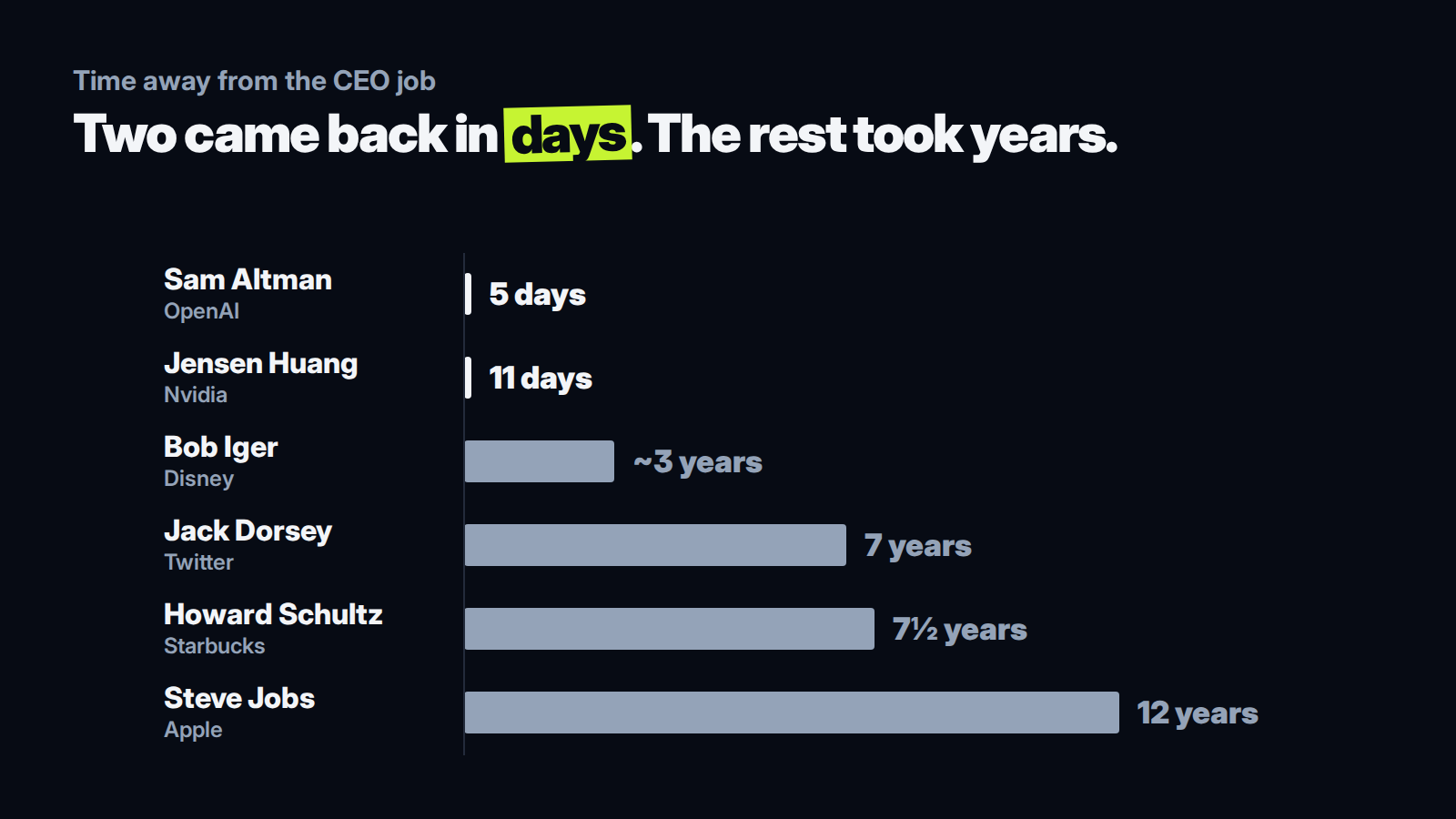
Sam Altman, OpenAI: 5 days. OpenAI's board fired Altman on November 17, 2023. Within days, employees and investors were pushing for his return, and a deal to bring him back was reported on November 22, with a new board replacing the one that fired him.
Bob Iger, Disney: almost 3 years. Iger handed the CEO job to Bob Chapek in February 2020. On November 20, 2022, Disney's board announced Iger was returning as CEO, effective immediately.
Jack Dorsey, Twitter: 7 years. Twitter's board pushed Dorsey out as CEO in October 2008 and gave the job to co-founder Evan Williams. Dorsey came back as interim CEO in mid-2015 and was named permanent CEO on October 5, 2015.
Howard Schultz, Starbucks: 7½ years. Schultz stepped down as CEO in June 2000 and returned as CEO on January 7, 2008, according to Starbucks' filing. He came back a second time, as interim CEO, in 2022.
Steve Jobs, Apple: 12 years. Jobs left Apple on September 16, 1985, after the board sided with CEO John Sculley in a fight over the company's direction. He became Apple's interim CEO on September 16, 1997, twelve years to the day.
Who actually decides
The details differ, but the mechanism is the same in every story. Shareholders elect the board. The board hires the CEO, and a majority of the board can remove the CEO. A founder's title, reputation or share count doesn't change that on its own.
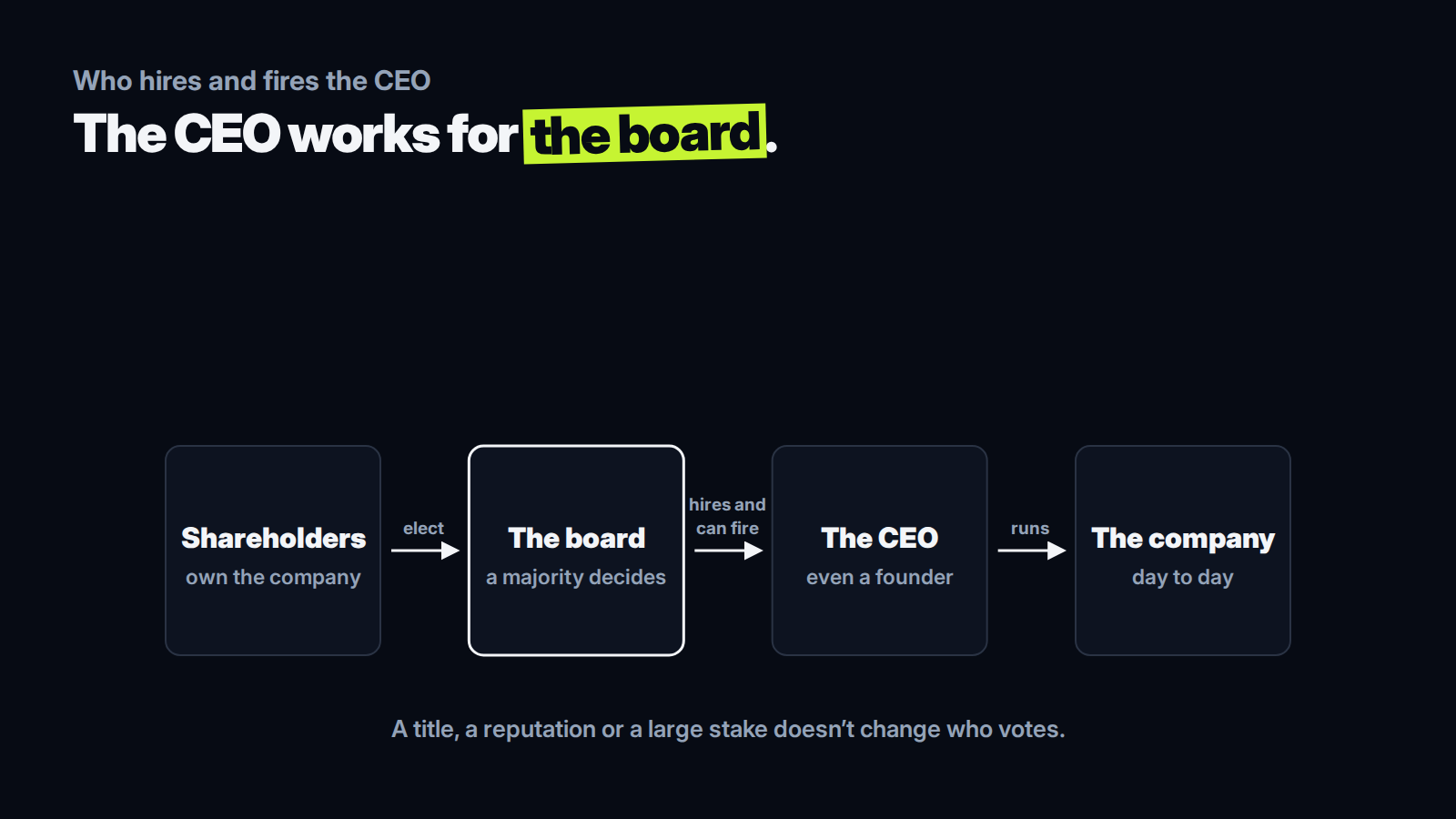
That's why Jobs could lose a vote at the company he co-founded, and why Twitter's board could replace Dorsey. It's also why OpenAI's board could fire Altman, and why pressure from the people around the company could bring him back days later. The comebacks happened the same way the exits did: a board decided.
How founders lose the majority
Most startups start with a board that the founders control, often just the founders themselves. Venture rounds change that. Lead investors commonly ask for a board seat, and later rounds can add more investor seats or an independent director.
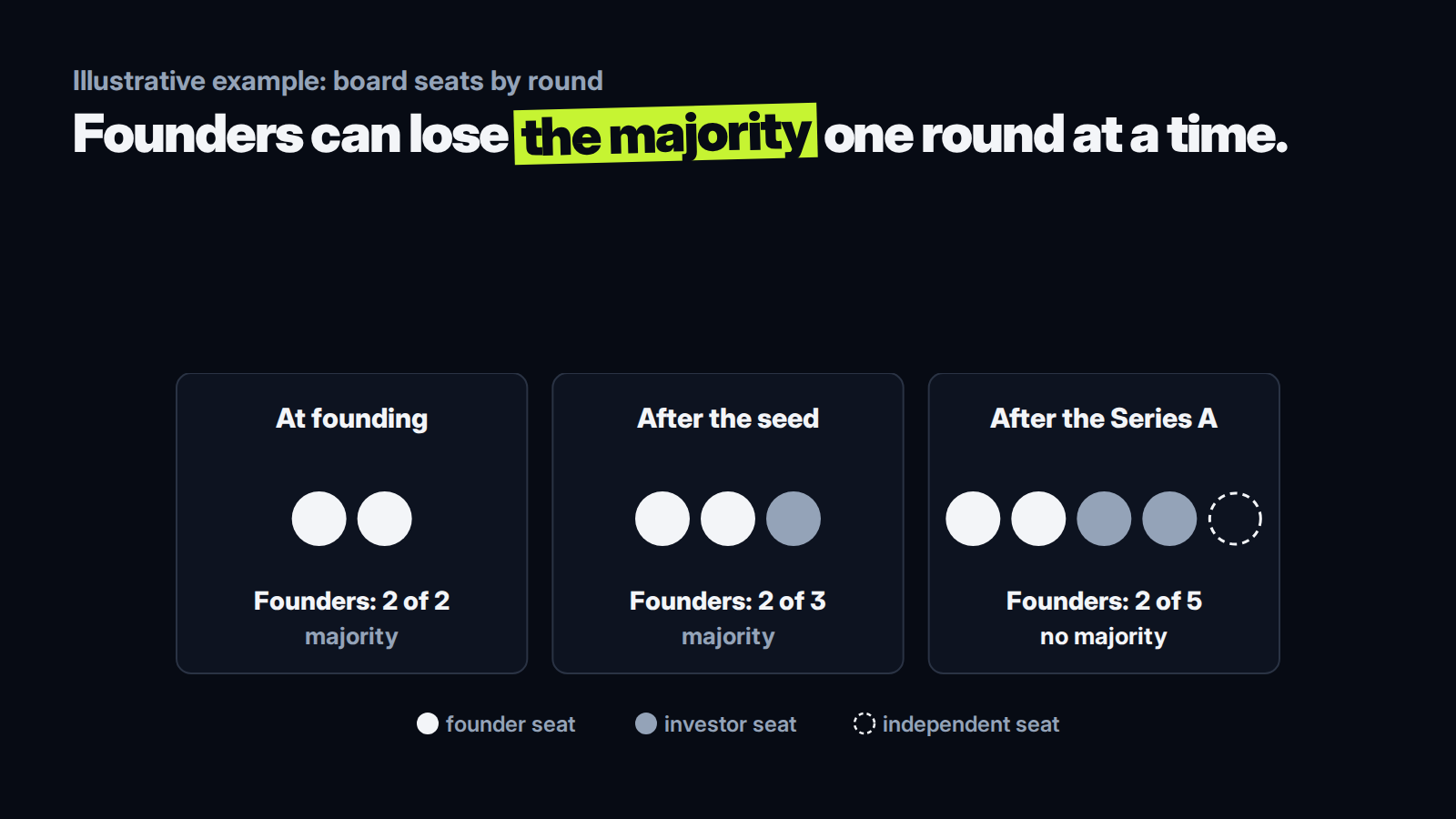
The example above is illustrative, not any specific company, but the pattern is common. Each change is reasonable on its own. Investors putting in millions want a say, and an independent director can be a real asset. The catch is that, in our view, many founders track their ownership percentage closely and their board math much less. Somewhere around the Series A, the founders may no longer hold a majority of the seats, and nothing about the day-to-day feels different until the board disagrees with them.
Owning a large share of the company and controlling the board are two different things. Board seats and voting rights are negotiated separately from valuation and equity, so they deserve the same attention.
What to negotiate before you need it
The CEOs above had famous names and still lost the vote. For a founder raising today, the time to think about board control is when the term sheet is on the table, not when the board is meeting without you.
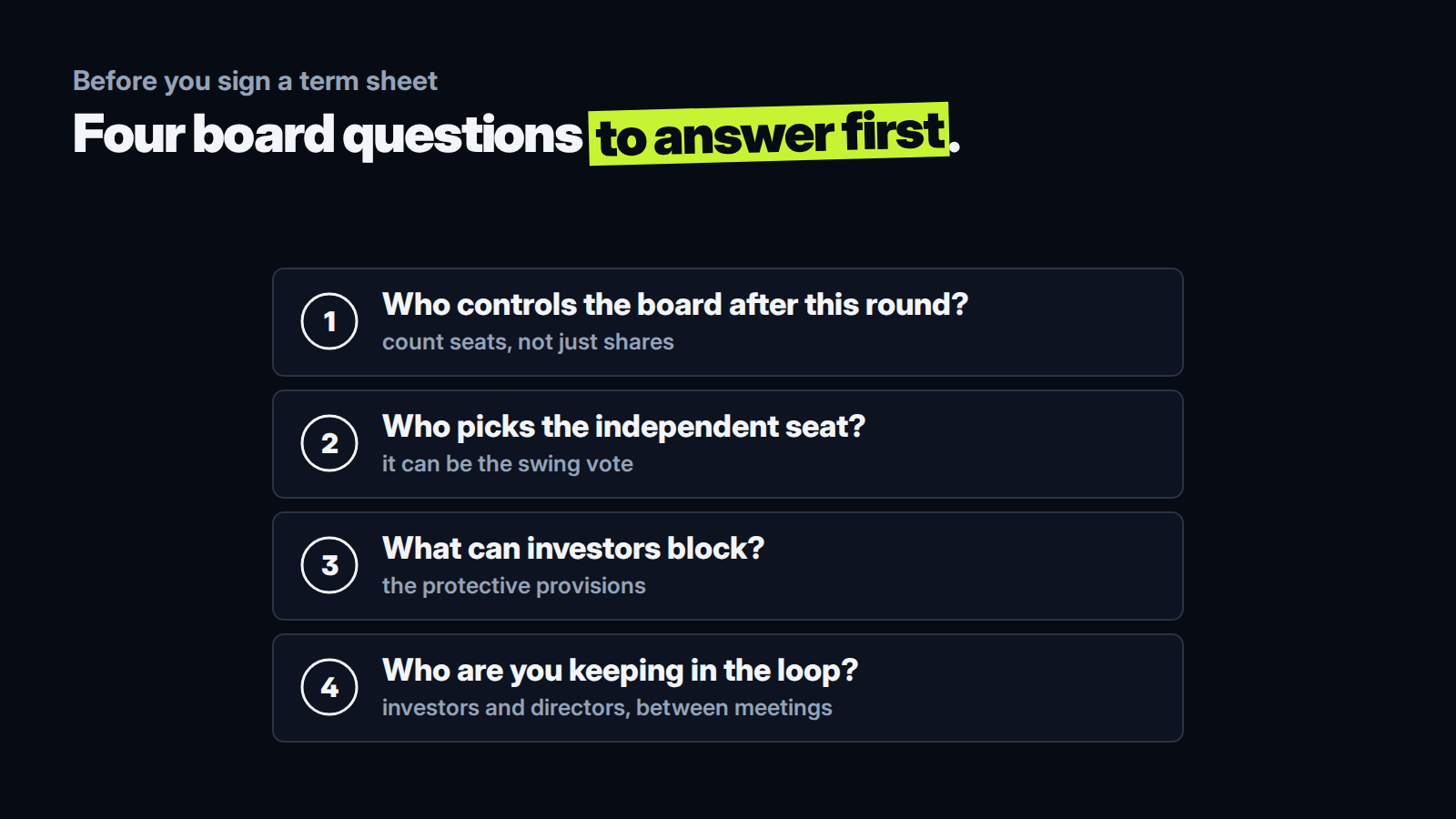
1. Who controls the board after this round?
Count the seats, not just the shares. Write down how many seats the founders, the investors and independents will hold after the round closes, and whether the founders still have a majority.
2. Who picks the independent seat?
When a board has an independent director, that person can be the swing vote. Find out whether the founders, the investors or both need to approve who fills the seat.
3. What can investors block?
Term sheets often include protective provisions: decisions that need investor approval no matter who controls the board. Read them as carefully as the valuation, and ask a lawyer what each one means in practice.
4. Who are you keeping in the loop?
Board fights are rarely won in the meeting itself. The founders who keep investors and directors informed between meetings have people who understand their decisions when it matters. A regular investor update is the simplest way to do that.
A quick checklist before you sign
- You know how many board seats the founders will hold after this round, and whether that's a majority.
- You know who chooses any independent director.
- You've read the protective provisions and know which decisions need investor approval.
- You have a regular rhythm for updating your investors and board, not just when something goes wrong.
See your startup the way investors do
The people on your board will judge your company the way investors do. TokenRoster gives you an investor-style assessment of your startup, so you see where the questions will come from before you're in the room. Get assessed
Sources
- Nvidia, Form 8-K filings: "NVIDIA announces CEO transition," November 12, 2026, and press release of November 23, 2026; Axios, November 23, 2026.
- Sam Altman: NPR, November 22, 2023; PBS NewsHour. The return was agreed late on November 21 (US time) and reported November 22, so the gap is 4 or 5 days depending on the time zone.
- Bob Iger: NPR, November 20, 2022; NBC News.
- Jack Dorsey: Fortune, September 30, 2015; Engadget, October 5, 2015.
- Howard Schultz: Starbucks, Form 8-K exhibit, January 2008; NPR, January 8, 2008.
- Steve Jobs: Cult of Mac; TechCrunch, September 16, 2008.
- The board-seat example is illustrative and doesn't describe any specific company.