How much did famous founders own at IPO? Gates, Bezos, Zuckerberg and 6 more
Bill Gates kept 45% of Microsoft. Jack Dorsey had 4.9% of Twitter. Nine founder stakes at IPO, why they differ, and what yours looks like after Series A.
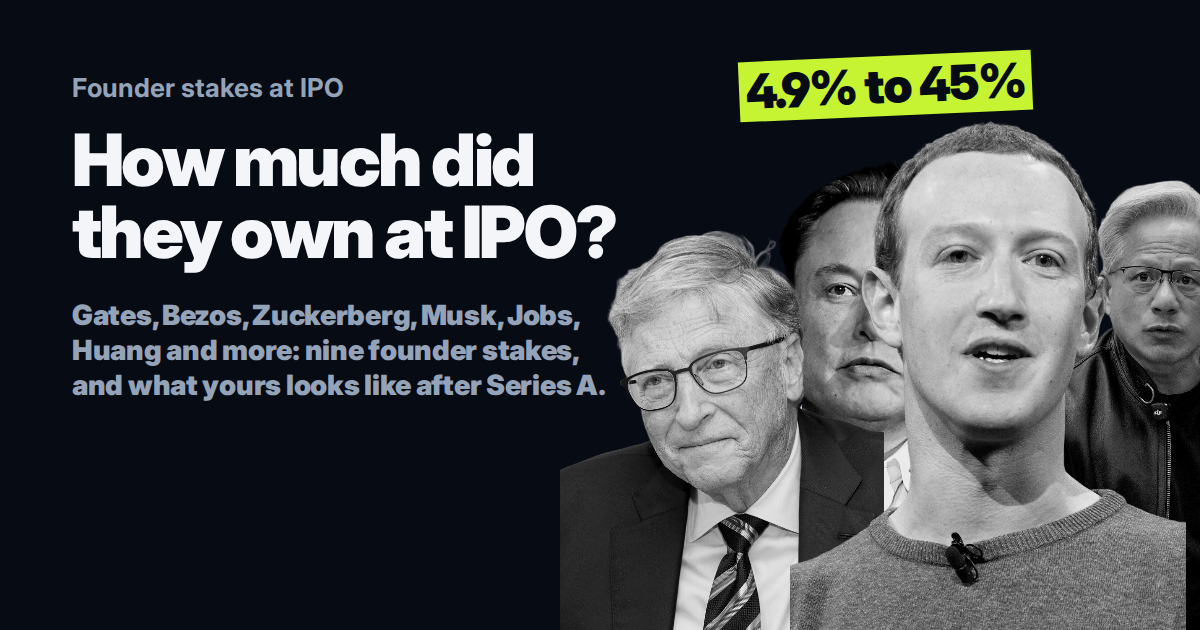
Bill Gates still owned 45% of Microsoft after it went public. Jack Dorsey owned 4.9% of Twitter. Both founded household names, and one kept about nine times as much of his company as the other.
Founder stakes at IPO vary that widely, and the reasons are the same ones that will shape your own cap table: how much money you raise, how many cofounders split the founder share, and how big the option pool gets. Here are nine famous founders, the stake each held at or around the IPO, and what drove it.
Nine founders, nine very different stakes
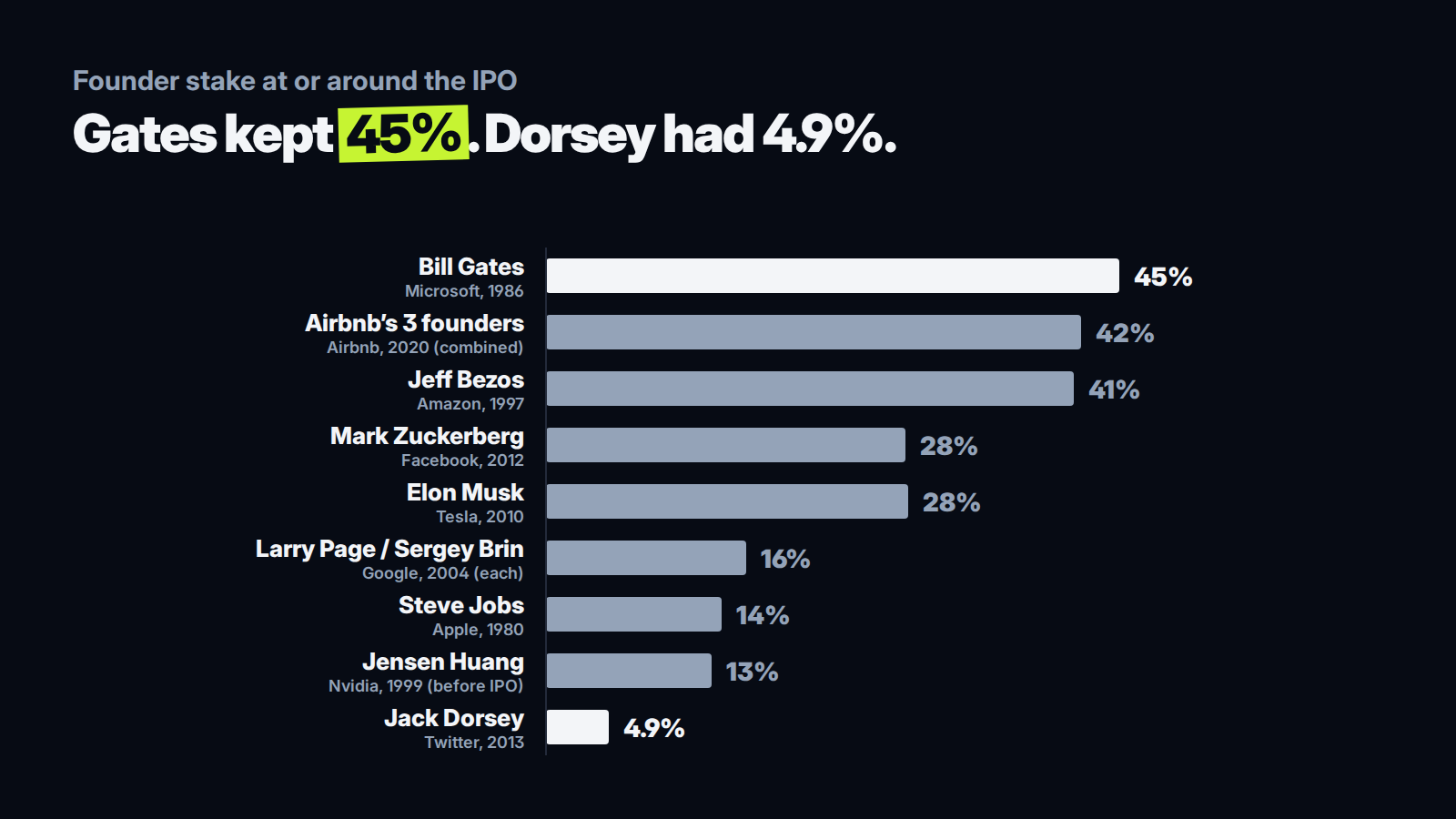
"Before" and "after" matter. An IPO sells new shares, so every existing holder, founders included, owns a slightly smaller percentage the day the company lists. Where the filings give both, both are below.
Bill Gates, Microsoft (1986): 45%. Microsoft was profitable early and took a single venture investment before going public. With so little outside money raised, there was little to dilute Gates, and he kept a 45% stake worth about $350 million after the IPO.
Jeff Bezos, Amazon (1997): 41%. Amazon's 1997 prospectus lists Bezos with 9,885,000 shares: 47.4% of the company before the offering and 41.4% after it.
Airbnb's three founders (2020): 42% combined. Brian Chesky, Joe Gebbia and Nathan Blecharczyk held 41.95% between them when Airbnb filed to go public. That's about 14% each: three founders kept a lot of the company together, even though none of them owned as much as Gates or Bezos alone.
Mark Zuckerberg, Facebook (2012): 28%. Facebook's filing showed Zuckerberg with 28.2% of the company. More on why that number understates his power below.
Elon Musk, Tesla (2010): 28%. Musk led Tesla's early funding rounds with his own money. After the IPO he owned about 28% of the company (28.4% as reported from the filing).
Larry Page and Sergey Brin, Google (2004): about 16% each. Google's filing showed Page with 15.7% and Brin with 15.6%, just over 31% together.
Steve Jobs, Apple (1980): about 14%. Jobs held 7.5 million shares when Apple went public, out of about 54.2 million outstanding after the offering. That's roughly 14%. Some later accounts round it up to 15% or 20%, but the share count supports about 14%.
Jensen Huang, Nvidia (1999): about 13%. Nvidia's prospectus shows Huang with about 13% before the IPO and about 11% after. Nvidia had three cofounders and several venture rounds before listing.
Jack Dorsey, Twitter (2013): 4.9%. Twitter's filing listed Dorsey with 23.4 million shares, 4.9% of the company. Cofounder Evan Williams owned more than twice as much. Twitter raised several large venture rounds before its IPO, and no founder kept a large slice.
Ownership isn't control
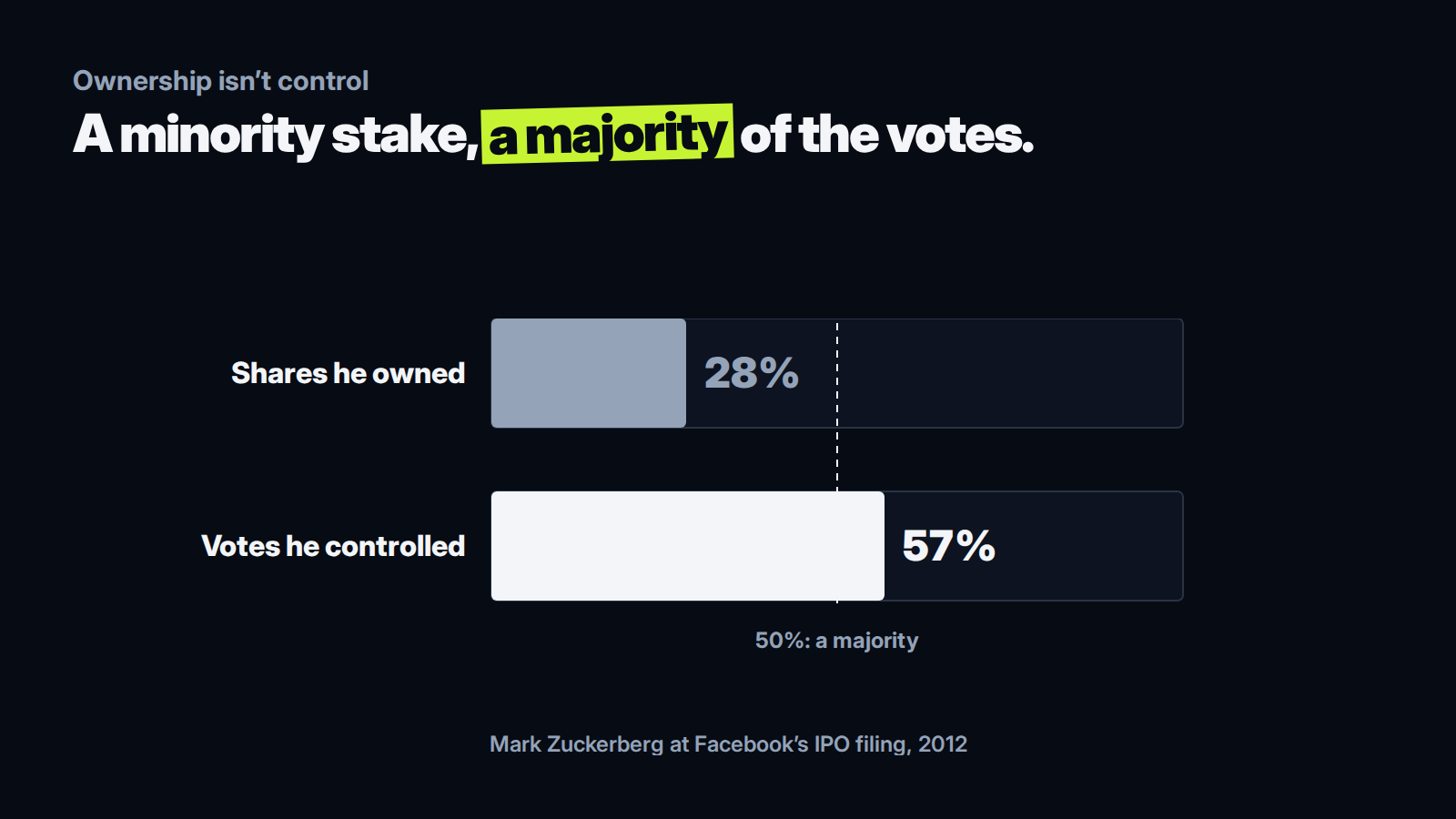
Zuckerberg owned 28% of Facebook at its IPO filing, but through Facebook's two classes of shares and voting agreements with other shareholders, he controlled well over half the votes. Google did the same thing in 2004: the founders' shares carried ten votes each, so Page and Brin kept control with a minority of the economic stake.
The lesson for founders: your percentage of the company and your say over it are two different numbers. Dual-class shares are rare at the startup stage, but board seats work the same way. Who holds the votes on the board matters as much as who holds the shares.
What decides how much a founder keeps
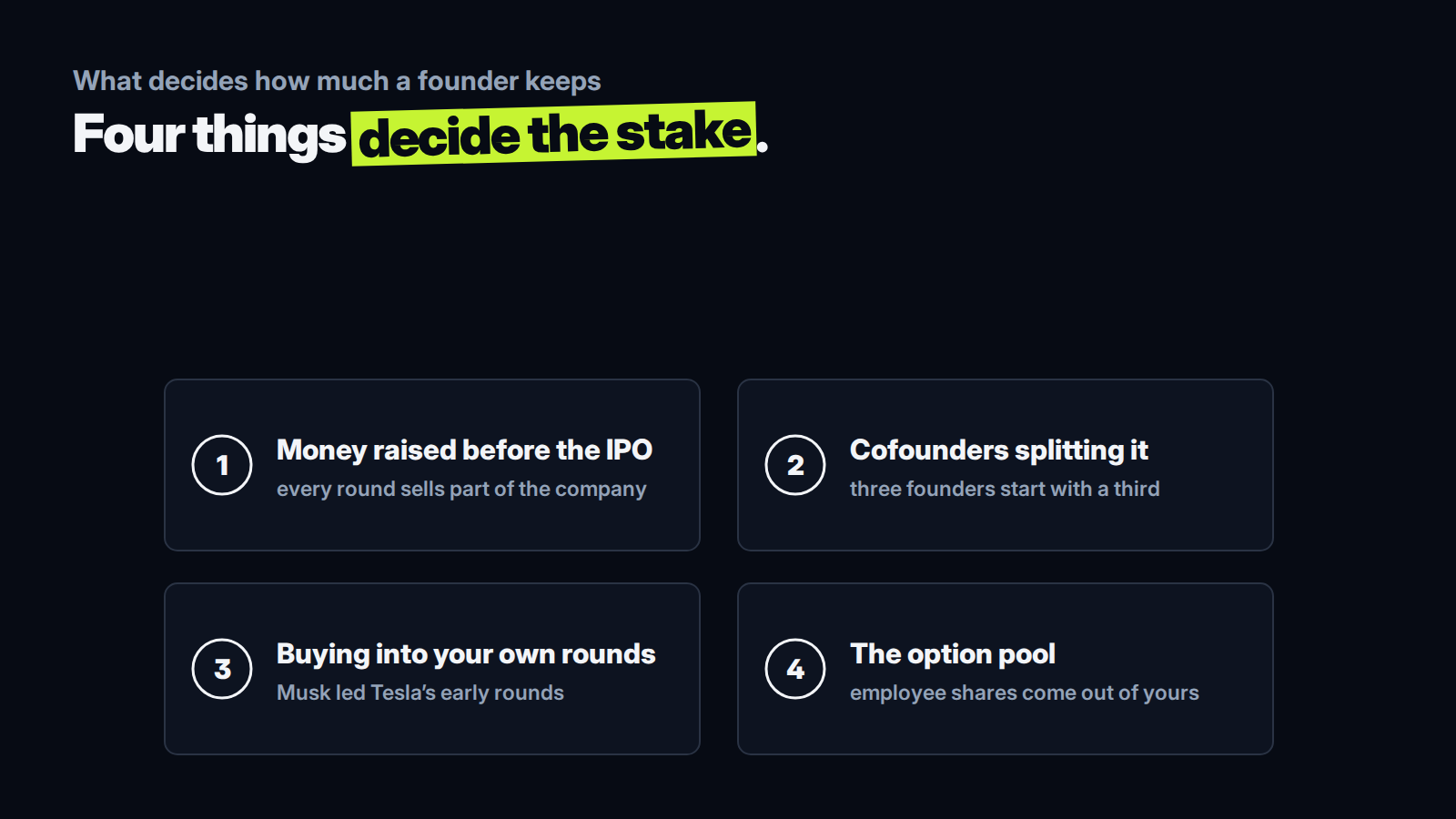
Line the nine up and the same four factors explain most of the spread:
- Money raised before the IPO. Every round sells part of the company. Microsoft and Amazon raised little before listing; Twitter raised a lot.
- Cofounders splitting the founder share. Two or three founders start by dividing 100% between them. Airbnb's 42% is about 14% each.
- Buying into your own rounds. Musk invested in Tesla's rounds himself, which offset part of the dilution.
- The option pool. Every employee's equity comes out of the same 100%, and pools are usually created or topped up right before a round, out of the existing holders' share.
And you? About 44% after Series A
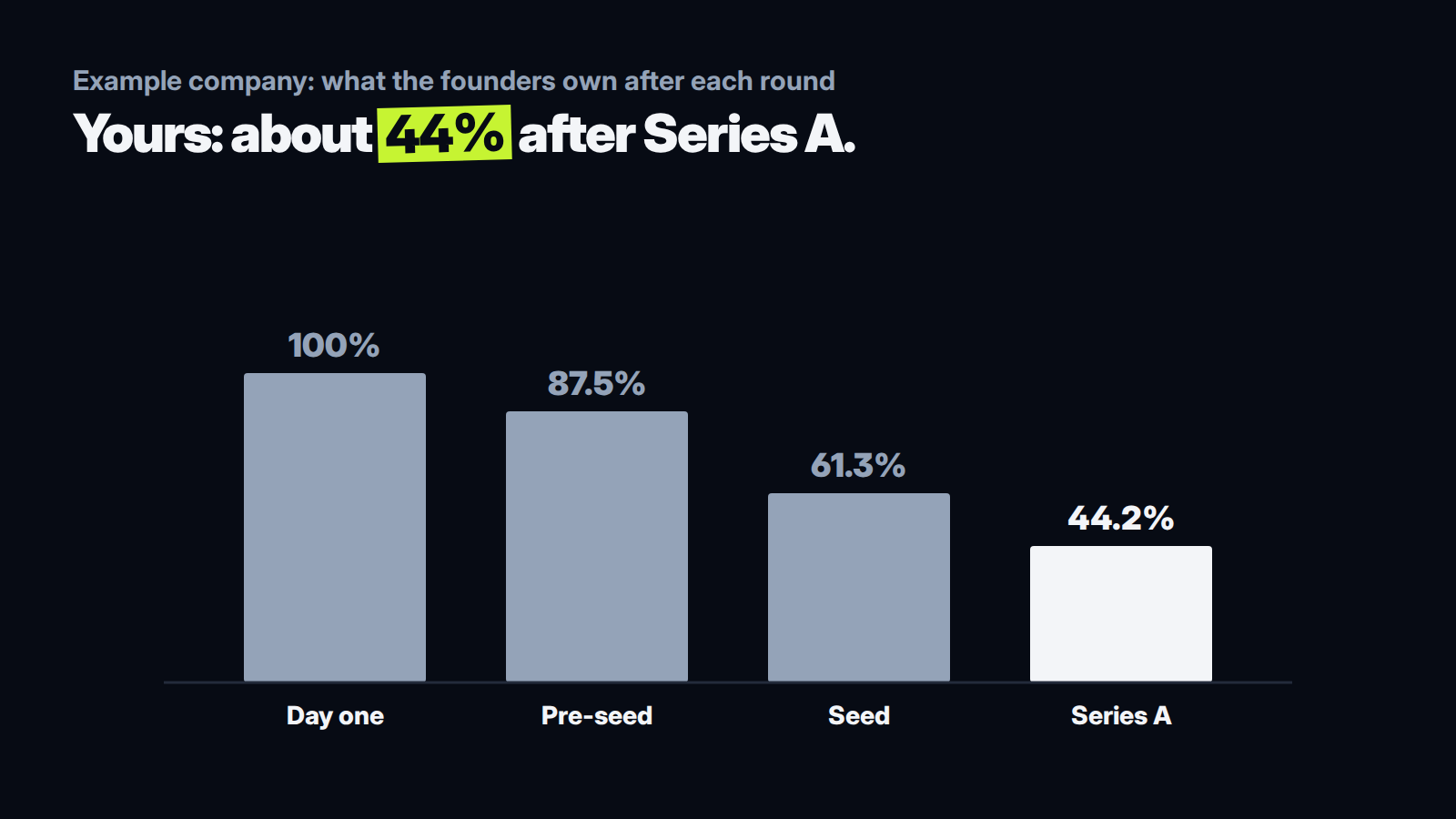
Famous IPOs are the far end of the road. Here's what the first three rounds look like for one example company with two cofounders:
- Day one: 100%. Two cofounders, no investors.
- Pre-seed: 87.5%. They raise $1.5M on a SAFE, which converts to 12.5%.
- Seed: 61.3%. They raise $5M. The seed fund takes 20%, and 10% goes to an option pool.
- Series A: 44.2%. They raise $15M. Series A takes 20%, and the option pool grows to 15%.
After three rounds, these founders own 44% between them, the same range as Bezos or the Airbnb founders at IPO, years before an IPO is on the table.
That isn't bad news. After the Series A, the example company is worth $75 million, so the founders' 44% is worth about $33 million. On day one, their 100% was 100% of an idea. Owning less of something bigger is the point of raising money.
The one term to watch: the option pool
Investors usually ask for the option pool to be created or enlarged before their money comes in. That means the shares for future employees come out of the founders' and existing holders' share, not the new investor's. A pool sized at 15% when your hiring plan only needs 8% gives away ownership for nothing. Size the pool to your real hiring plan for the next 18 to 24 months, and bring that plan to the negotiation.
See your startup the way investors do
Every round you raise is priced by how investors see your company. TokenRoster gives you an investor-style assessment of your startup, so you know where the questions will come from before you're in the room. Get assessed
Sources
- Microsoft: Microsoft; Fortune, March 13, 2011.
- Amazon: 1997 prospectus, Principal Stockholders table (SEC EDGAR).
- Airbnb: TechCrunch, November 16, 2020.
- Facebook: TechCrunch, February 1, 2012 (28.2% stake); voting power of about 57.3% after the IPO from Facebook's amended S-1, May 2012.
- Tesla: TechCrunch; UPI, June 29, 2010.
- Google: InformationWeek / AP.
- Apple: Motley Fool; TechCrunch.
- Nvidia: KR-Asia; VnExpress.
- Twitter: Quartz.
- The example company is illustrative and isn't legal or financial advice.
- Hero photos via Wikimedia Commons (cut out, black and white): Zuckerberg: Anthony Quintano, CC BY 2.0; Gates: European Commission, CC BY 4.0; Musk: U.S. Air Force / Trevor Cokley, public domain; Huang: Anders Eidesvik, CC BY 4.0.